
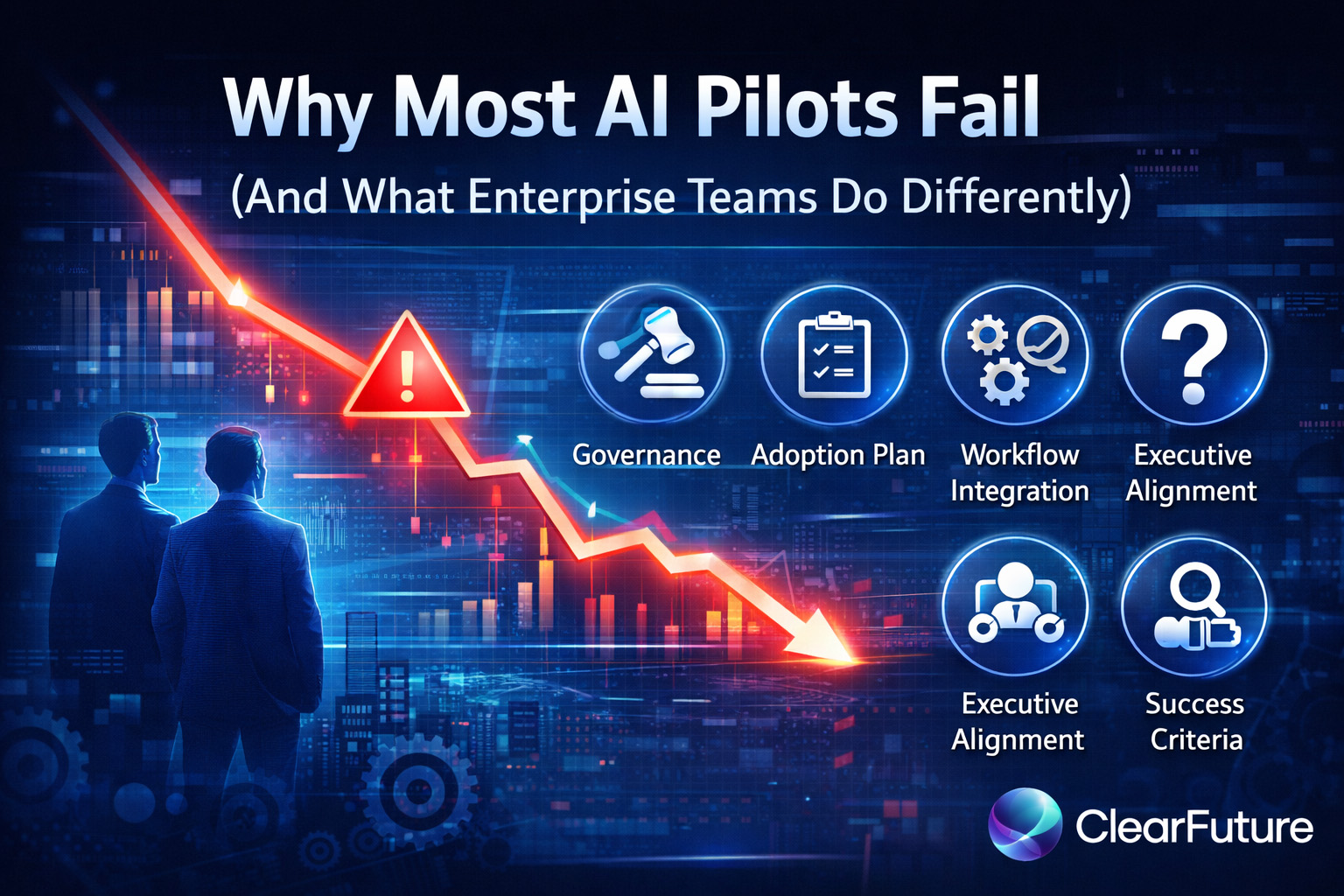
The Pilot Trap
Most enterprises have launched at least one AI pilot. The majority of those pilots never reach production. Industry estimates suggest that between 70% and 85% of AI projects fail to deliver business value at scale. The problem is rarely the technology.
Failed pilots share a common pattern: a small team builds an impressive demo, leadership is briefly excited, and then the initiative slowly loses momentum as organizational reality sets in. Understanding why this happens — and what successful teams do differently — is essential for any enterprise serious about AI adoption.
Five Reasons Pilots Fail
1. Lack of Governance
Pilots launched without governance frameworks operate in a vacuum. There are no clear policies for data usage, model behavior, or escalation procedures. When questions arise — and they always do — there is no structure to provide answers. The pilot stalls while the organization debates issues that should have been resolved before launch.
Successful teams establish lightweight governance before the pilot begins. This does not mean bureaucracy; it means clear ownership, defined boundaries, and agreed-upon decision-making processes.
2. No Adoption Plan
Building an AI capability and getting people to use it are fundamentally different challenges. Many pilots focus exclusively on technical functionality without considering the user experience, change management, or training required for adoption. A technically excellent tool that nobody uses delivers zero value.
Successful teams co-design with end users from day one. They invest as much in adoption planning as in technical development, and they measure usage alongside performance.
3. No Workflow Integration
Standalone AI tools create friction. If using the AI requires employees to leave their existing workflows, open a separate application, or change established processes, adoption will be minimal. The best AI is invisible — embedded in the tools people already use.
Successful teams identify specific workflow insertion points before building anything. They ask: 'Where in the existing process will this AI deliver value without adding steps?'
4. No Executive Alignment
Pilots launched by individual teams without executive sponsorship lack the organizational authority to overcome inevitable obstacles — budget constraints, cross-departmental dependencies, IT security reviews, and competing priorities. Without a senior champion, pilots are the first initiative cut when resources tighten.
Successful teams secure executive sponsorship that includes not just approval but active involvement. The executive sponsor removes blockers, allocates resources, and signals organizational priority.
5. No Measurable Success Criteria
If you cannot define success before the pilot begins, you cannot demonstrate it afterward. Many pilots launch with vague objectives like 'explore AI capabilities' or 'improve efficiency.' These are aspirations, not success criteria.
Successful teams define specific, measurable outcomes before launch: time saved per task, error reduction rates, user satisfaction scores, or revenue impact. They instrument the pilot to capture these metrics from day one.
The Structural Difference
The difference between pilots that fail and those that scale is not technical sophistication — it is structural discipline. Successful enterprise AI initiatives treat pilots as the first phase of a production rollout, not as experiments. They build governance, adoption, integration, sponsorship, and measurement into the pilot design from the beginning.